Medical Practice · Surgical & Regenerative
Ultrasound-Guided Procedures
Real-time ultrasound imaging guides blood draws and therapeutic injections precisely — fewer needle sticks, greater accuracy, and improved safety.
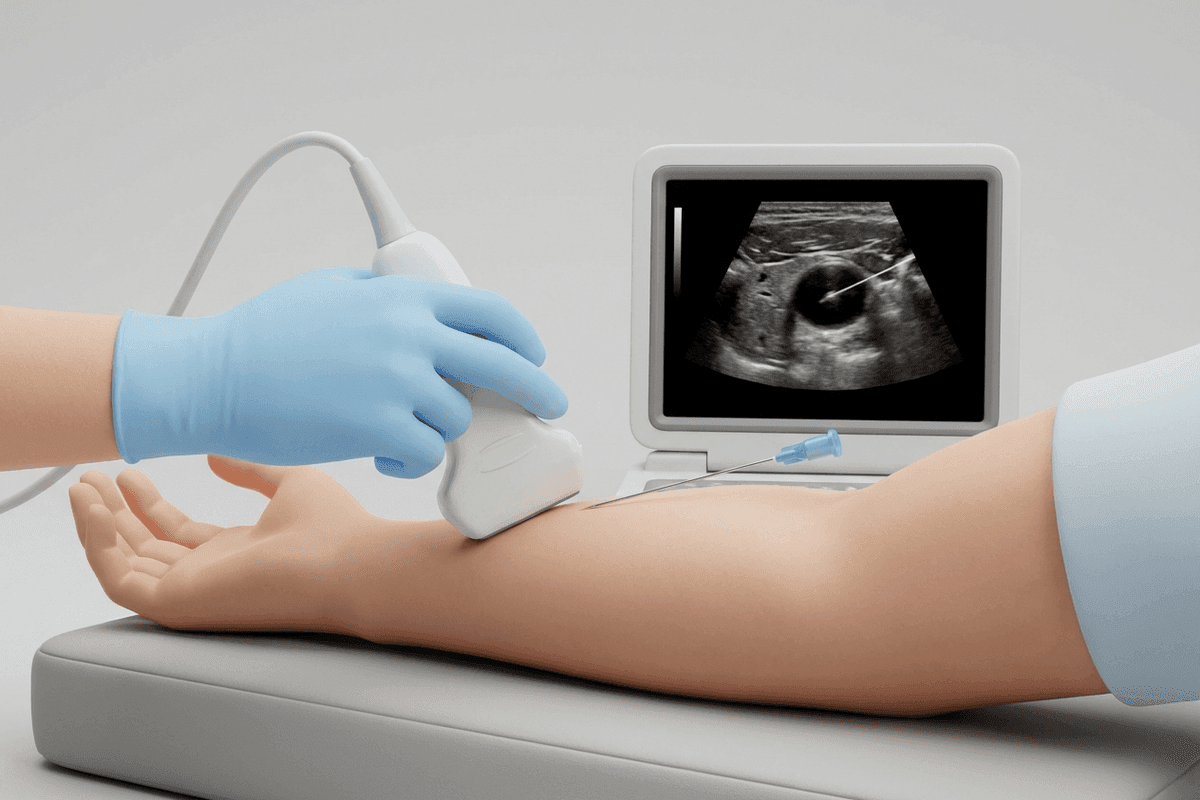
Ultrasound-guided blood draw: An ultrasound-guided blood draw uses real-time ultrasound imaging to locate veins that are difficult to see or feel. A trained medical professional uses a handheld ultrasound probe to visualize the vein and guide a needle directly into the blood vessel, increasing the likelihood of successful access on the first attempt. This technique minimizes discomfort and reduces the need for multiple needle sticks. It is recommended for patients with difficult venous access, including those who have deep veins that cannot be easily felt through the skin, chronic illnesses requiring frequent blood draws or IV access, scar tissue from repeated needle insertions, veins that are dehydrated or collapse easily, or other physical characteristics that make veins difficult to locate. Ultrasound-guided injection: An ultrasound-guided injection is a minimally invasive procedure in which a healthcare provider uses live ultrasound imaging to precisely guide a needle into a joint, tendon, bursa, muscle, or around a nerve. This allows medication — typically a local anesthetic or other therapeutic agent — to be delivered directly to the source of pain or inflammation, improving accuracy, effectiveness, and safety. Your provider may recommend an ultrasound-guided injection to improve the accuracy of medication placement, diagnose the source of pain, treat joint, tendon, ligament, bursa, or nerve-related conditions, reduce inflammation and relieve pain, or avoid nearby nerves, blood vessels, and other important structures. Compared with traditional landmark-guided techniques, ultrasound guidance offers several important advantages: • Greater accuracy — real-time imaging allows precise needle placement • Fewer needle sticks — significantly reduces failed attempts and repeat insertions • Increased comfort — less tissue trauma results in less pain and bruising • Improved safety — helps avoid nerves, arteries, and other sensitive structures • Better treatment outcomes — ensures medication reaches the intended target for maximum effectiveness • Faster care — reduces delays by improving first-attempt success, especially in patients with difficult vein access
Also in surgical & regenerative