Dental Practice · Restorative Dentistry
Onlays
Custom "partial crown" restorations that rebuild damaged cusps and protect the tooth while preserving healthy structure.
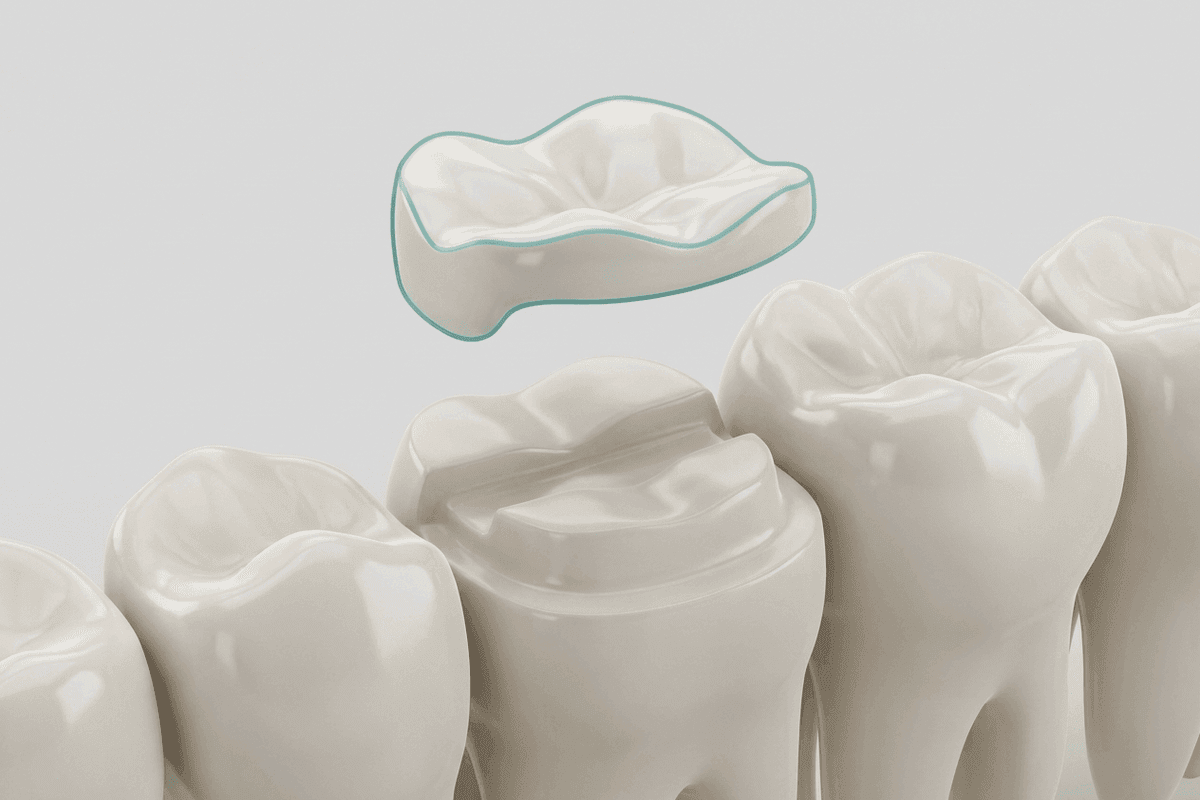
When a tooth has more damage than a filling can reliably restore, but not so much that it needs a full crown, an onlay is the conservative answer. An onlay is a custom-made restoration that rebuilds one or more of the chewing cusps of a back tooth, bonded into place to restore the tooth's original strength and shape while preserving the healthy structure a crown would otherwise remove. The distinction matters. A large direct filling at a high-stress site can flex and leak over time, and eventually crack the tooth it was meant to save. A crown solves the strength problem but requires reducing the entire tooth. An onlay sits in between: it covers and protects the vulnerable cusps without sacrificing sound tooth structure, which is why it is often called a "partial crown." We design onlays from a digital scan with our 3Shape Trios scanner — no putty impression trays — and the restoration is fabricated from tooth-colored ceramic or composite that matches the surrounding enamel. Because the bond seals the margin against bacteria, a well-placed onlay both restores function and protects the tooth from further decay. Onlays are indicated for teeth with large failing fillings, fractured cusps, or decay too extensive for a direct restoration, but where enough healthy tooth remains to avoid a crown. The procedure typically takes two visits — one to prepare and scan the tooth, one to bond the finished restoration — with a temporary in between. (An inlay is the same idea for damage that sits within the cusps rather than across them; we choose between the two based on exactly what the tooth needs.)
Also in restorative dentistry
Related services
Composite Fillings
Tooth-colored composite restorations placed to halt decay and restore tooth function.
Direct Composite Veneers
Esthetic-focused composite veneers placed in a single visit. Conservative and reversible.
Porcelain Veneers
Custom-shaped porcelain shells that change a smile with minimal reduction of the underlying teeth.
Crowns & Bridges
Full-coverage restorations and multi-tooth bridges that restore function and protect the tooth.
Dentures & Partial Dentures
Full and partial removable prosthetics, including immediate dentures.
Teeth Whitening
In-office and at-home whitening, including deep-bleaching for stubborn cases.