
Personal Blog

New technology in preparation for 2024
As our practice continues to grow, we have developed the need for the ability to process multiple digital scans for fabricating our numerous oral prostheses, orthotics, splints and restorations. While our 3shape Trios 3 was upgraded with new hardware, we could not keep up with our patient demand. Therefore in 2023, we added the new award winning 3shape Trios 5, and wirelessly connected the intra-oral scanner to all the computers in our operatories. With both machines running simultaneously, we have been able to help treat our patients efficiently without compromising our quality of care.

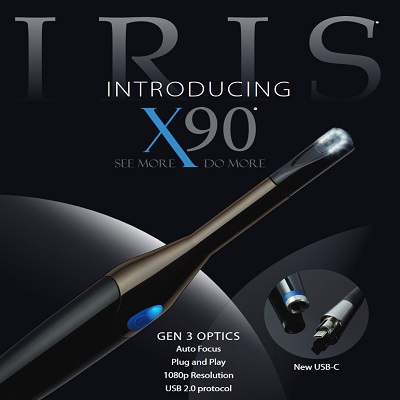
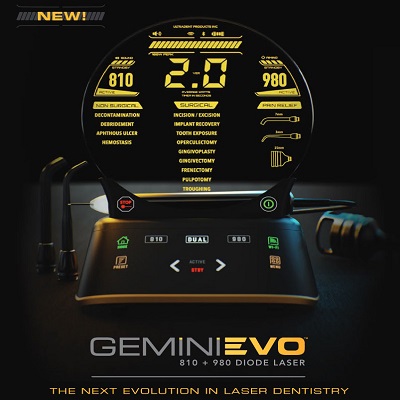
Our office also decided to upgrade all our intra-oral cameras to the most advanced technology: the Iris X90, allowing us to take accurate intra-oral photos to help educate our patients and provide vivid records. In an effort to improve our photobiomodulation orofacial pain and soft tissue surgery departments we have upgraded our diode laser to the new Gemini Evo. With these new additions, we hope to continue to maintain our excellence in patient care.
CBCT Accreditation
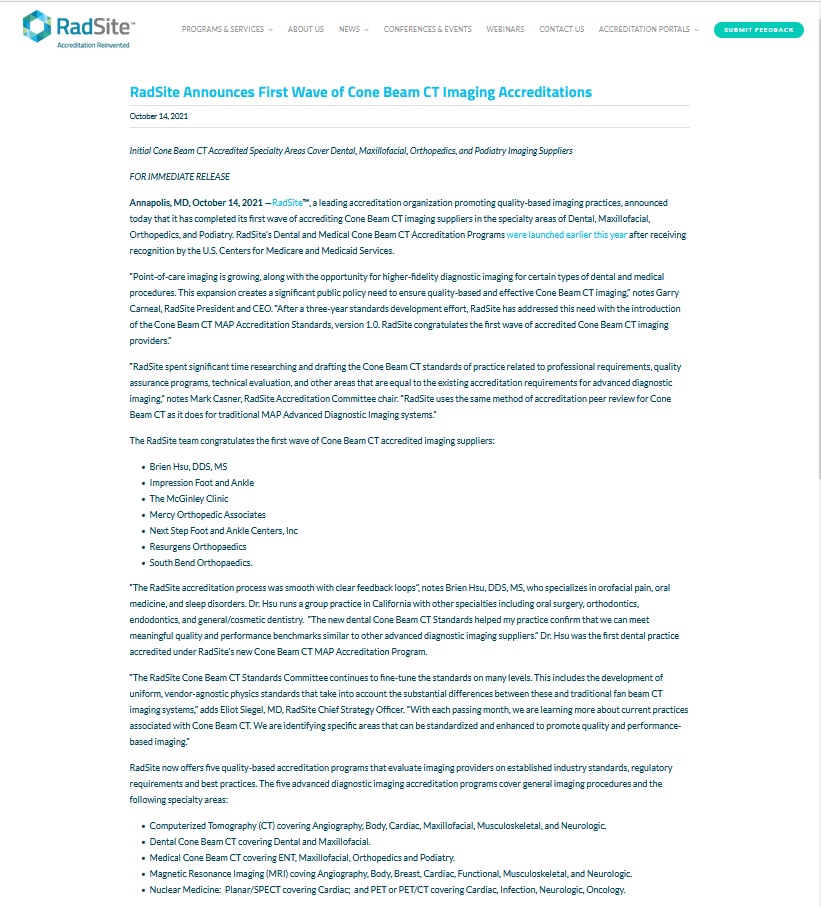
We are proud to be the first dental office in the United Stated to complete the robust accreditation standards created by Radsite for Cone Beam Computed Tomography (CBCT) imaging and exams. This certification assures our patients that we have been thoroughly evaluated and approved on all metrics in regards to best practices and safe, high quality medical testing for CBCT. As one of the premiere medical/dental practices in Rancho Cucamonga we are committed to the safety of our patients and providing the highest quality in care.
COVID-19 Vaccination
I think many will agree that so far the greatest thing about 2021 is that it puts 2020 behind us.  We have all endured and have been trying to overcome a multitude of hardships from 2020 – from protests, to wildfires, earthquakes to of course COVID-19. While we started off 2021 with a historic riot, I think with the advent of the COVID-19 vaccine, there is hope that we may reach the end of the tunnel of our pandemic through herd immunity. Many patients have asked if we plan on being some of the first to take one of the U.S. made vaccines … and if so which one?
I’m pleasantly optimistic to say that as of 1/14/21, I have been inoculated with my first dose of the Moderna vaccine. The process was relatively straight forward. I registered for a drive through location, arrived a few minutes early and waited in line in my car. 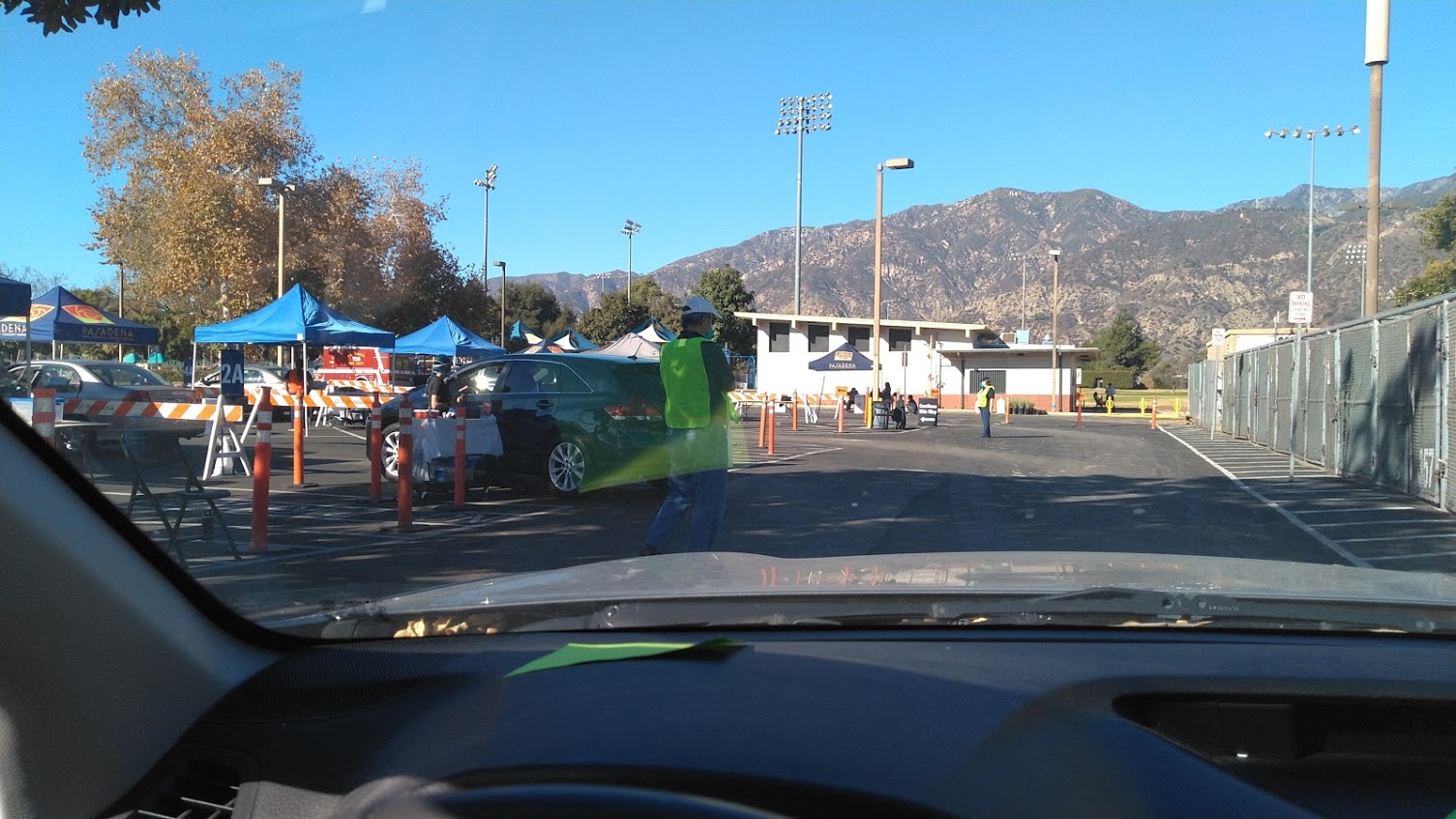 Once I presented my credentials, they asked a few questions and I was given the jab. I was then instructed to park near some medical staff for observation for 15 minutes and released once I reported no side effects.
Day 1 of Moderna Vaccine 1/14/2021: Very mild soreness in my left arm near injection site.
Day 2 of Moderna Vaccine 1/15/2021: Increase to medium/mild soreness in my left arm near injection site.
Day 3 of Moderna Vaccine 1/16/2021: Down to very mild soreness in my left arm near injection site.
Day 4 of Moderna Vaccine 1/17/2021: I have grown a third arm! My left arm feels fine.
While I believe all the vaccines for COVID-19 will help us overcome this pandemic, many ask why did I choose Moderna vs Pfizier? Below were my reasons as of 1/17/2021:
Moderna’s efficacy rating after the 2nd dose was at 94.1%. While it’s lower than the 95% from Pfizier – one has to remember Pfizier originally published a rate of 90% and then after a few days of Moderna publishing their rate of 94.1%, Pfizier miraculously raised their efficacy of the 2nd dose to 95%...
Moderna’s efficacy after the first dose is between 80-90% efficacy; Pfizier is between 50-60%.
Moderna’s vaccine is stable for up to 30 days in a regular refrigerator or 12 hours room temperature and is ready to dose without dilution; Pfizier is stable for 5 days or 2 hours room temperature and needs to be diluted with sterile 0.9% Sodium Chloride Injection.
Moderna’s side effects per FDA:
- Injection site pain
- Fatigue
- Headache
- Muscle pain
- Joint pain
- Chills
- Swollen lymph nodes
Pfzier’s side effects per FDA:
- Injection site pain
- Tiredness
- Headache
- Muscle pain
- Chills
- Joint pain
- Fever
- Injection site swelling
- Injection site redness
- Nausea
- Feeling unwell
- Swollen lymph nodes
Some people ask why not wait for AstraZeneca-Oxford vaccine? I have more trust in US made health care products and more importantly the efficacy of AstraZeneca-Oxford is at 70.4% - which is quite a drop to 94.1-95%. For my safety and the safety of my patients and family, I would prefer to go for a better efficacy. However please note that 70.4% is still far superior than our annual flu vaccine, which per the CDC is around 40-60%. Although there are no numbers out yet, Johnson & Johnson (another US based company) will soon be out with their own vaccine. The preliminary information reports that this will be a single dose vaccine (vs 2 dose system of Modena/Pfizier) – making it faster to inoculate the United States. Unfortunately, the data on their stage 3 trials are not out and so final efficacy is still in question. IMHO, please stay with a US made vaccine because all their testing data is open to the public and reviewed by an independent panel. In addition, they are better tested, safer and as of now, offer a higher efficacy:
UK: AstraZeneca-Oxford (Reviewed by independent panel, data is open to public)- 70.4% Efficacy
China: Sinovac (1st reviewed by unknown person(s). Second reviewed by Brazil. Data is closed to the public)– started at 78% and now down to 50.38% Efficacy
China: Sinopharm - (Reviewed by unknown person(s). Data is closed to the public) started at 86% and now down to 79.34% Efficacy
Russia: Sputnik V-9 (Self reviewed. Data is closed to the public) started at 95% then went 91.4%, as of January 2021 it’s now down to 73-85% Efficacy
Hanna Hsu Update
Many friends and patients have asked about updates to my daughter and her congenital heart defect. The memories of those long, grueling and depressing nights at Children’s Hospital Los Angeles (CHLA) have seared a permanent scar in my life and it’s not something I enjoy reliving. However for the sake of closure, I will try and summarize those traumatic events rather quickly.... We will begin during the time after Hanna's first successful open heart surgery (Blalock shunt procedure) - performed when she was around 9 days old ...
The months that we spent their holding Hanna’s little hands and hoping for the day that we could take her home seemed endless. It’s interesting how we take the simplest things in life for granted. I remember watching other babies effortlessly drink a bottle of milk on their own, in one feeding and contemplating how lucky they were …. we were struggling just to get Hanna to drink 1-2 milliliters (mls) of fluid using a pipette. During those harrowing nights in the hospital, our ears would be engulfed with the sounds of multiple alarms going off every few minutes as a result of other infants on the floor losing oxygen too rapidly or with the perpetual screams of pain after having their chest bones cracked open during open heart surgery. Sometimes my wife or I would get up from our area and try and comfort the other babies … but honestly how to console an infant who only weighs 5-10 lbs, has a fractured sternum with multiple stitches down a 5-7 inch incision, tubes protruding out of their nose, arms and legs and suffocating from hypoexima (from not being able to supply enough oxygen to your brain because of a defective heart)? Then on those rare, dreadful occasions, we would hear a different alarm go off across the floor, followed by an emergency code announced over the speaker and finally accompanied with the sounds of hurried footsteps as a wave of nurses and doctors rushed to an ominously silent infant. Those horrible nights seem to last an eternity in the hospital … nights went into days and then into weeks and ultimately into months. Even when we were finally ready to bring her home, Hanna had to be monitored carefully – not to have her cry for too long or her lips and face would turn blue or not to over tax her body from the exhaustion of trying to drink 10-15 mls of milk. All the while my wife or I would be prepared to administer emergency infant CPR should her her heart fail. Thankfully gone are the days of having to strap a pulse oximeter monitor on her little fingers with alarms and oxygen tanks stored near her baby crib.
Hanna would eventually need a second open heart surgery at around 6 months old – which we had to push to get modified. My wife had forwarded her case to Best Doctors for review. They then sent her file to Dr. Nido over at Boston Children’s Hospital. (Many experts consider him the top pediatric cardiovascular surgeon in the world). He had recommended that we do decompression of the hypoplastic right ventricle during the Glenn surgery - in the hopes that we stimulate growth of her right ventricle therefore avoiding a third open heart surgery. After review of the recommendations, CHLA and Dr. Starnes (another one of the world renown pediatric cardiovascular surgeons) agreed to proceed with this modification given that there was little additional risk and it would give Hanna a chance to improve her heart condition. Fortunately, the surgery went well, and our baby girl only needed a few weeks of recovery at the hospital (vs the few months after her first surgery).
[caption id="attachment_3227" align="alignright" width="228"] Hanna Hsu 2020[/caption]
Fast forward to today (11 years later). Hanna is doing well. She still has her bi-annual cardiovascular check-ups. So far, she has avoided the need for any other surgeries, and we hope that the surgery modification that they had performed during the Glenn, may perhaps set precedent in helping other children with similar defects. While her blood oxygen level is still not comparable to that of a healthy person, she is for the most part healthy and has grown into a bright and beautiful girl.
Due to her heart condition, Hanna’s physical endurance is a lot lower than those of her peers. However, she has found enjoyment in other non-physical activities, such as reading and writing. Recently we are proud to announce that she won first place in the Clear Water TBM Naming Contest:

i-CAT FLX 3D Cone Beam Computed Tomography (CBCT) system
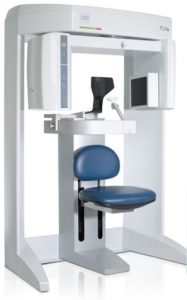 BCT manufacturers know that the award winning i-CAT FLX technology is regarded as the cone beam industry standard. In addition, the i-CAT would allow more detail with less radiation – a scan has a dose equivalent to the average radiation exposed to a person going about their "normal" life in the USA for a few days. However, being the best when it comes to CBCT technology comes with a high cost and we had just paid off our 5-year financing for the Rayscan… Yet I strongly believe that limiting the radiation exposure each patient receives, while giving us the best imaging quality would make this investment well worth it.
Hence in late February of 2020 we upgraded to the i-CAT FLX and the consensus from our staff and patients have been positively enthusiastic. One of our goals at our group practice is to have the most state-of-the-art, accurate technology to assist in diagnosis and treatment of our patients. We feel the i-CAT will allow us to continue our excellent standard of care in achieving success for our patients.
BCT manufacturers know that the award winning i-CAT FLX technology is regarded as the cone beam industry standard. In addition, the i-CAT would allow more detail with less radiation – a scan has a dose equivalent to the average radiation exposed to a person going about their "normal" life in the USA for a few days. However, being the best when it comes to CBCT technology comes with a high cost and we had just paid off our 5-year financing for the Rayscan… Yet I strongly believe that limiting the radiation exposure each patient receives, while giving us the best imaging quality would make this investment well worth it.
Hence in late February of 2020 we upgraded to the i-CAT FLX and the consensus from our staff and patients have been positively enthusiastic. One of our goals at our group practice is to have the most state-of-the-art, accurate technology to assist in diagnosis and treatment of our patients. We feel the i-CAT will allow us to continue our excellent standard of care in achieving success for our patients.Zeiss Dental Microscope
